RYGH Donated 10,000 RMB for flood disaster in Henan Province, China

A once-in-a-thousand-year rainstorm! The flood in Henan is not accidental. The global flood attracts attention!
From 6:00 on July 19 to the evening of July 20, there was a rainstorm in Zhengzhou, Henan Province. The water level of many rivers in Zhengzhou continued to rise and there were dangerous situations. Many reservoirs exceeded the flood limit water level, and the water accumulation in the urban area was serious. From 17:00 on July 20, Zhengzhou upgraded the flood control level II emergency response to level I. According to the relevant provisions of the national emergency plan for flood control and drought relief, the national flood control headquarters decided to start the level III emergency response for flood control at 20:00 on July 20.
On the 19th, 794 stations in Henan experienced heavy rain (more than 100 mm), Zhengzhou and Pingdingshan in Henan experienced heavy rain, and the daily rainfall of five national meteorological observation stations such as Songshan has exceeded the extreme value since meteorological records.
According to @ Zhengzhou Meteorological News, from 08:00 to 17:00 on the 20th, there was a heavy rainstorm in Zhengzhou, with the intensity of "once in a thousand years".
The torrential rain in Henan these two days has worried many people. RYGH Donated 10,000 RMB for flood disaster in Henan Province, China.I have also seen many people's support and help for Henan on the Internet. Chinese people are one heart and we are all in the face of disasters. You should know that in addition to making donations, your online solidarity with Henan is not unhelpful. Encouragement can arouse people's hope, urge people to forge ahead and insist. Our concern and support for Henan also hope to convey the past and people in Henan can receive it. Henan come on! The difficulties will surely pass!
In recent years, catastrophic floods and other extreme weather events have shown an upward trend. The Chinese Academy of Meteorological Sciences published a study entitled "changes of sustained and unsustainable extreme precipitation in summer from 1961 to 2016 in China", Based on the daily precipitation observation data of more than 2400 stations from 1961 to 2016 provided by the National Meteorological Information Center, this paper analyzes the variation characteristics of sustained (lasting for 2 days or more) and unsustainable (lasting for 1 day) extreme precipitation events in summer in China, and finds that the trend of extreme precipitation in China is becoming more and more obvious from 1961 to 2016.
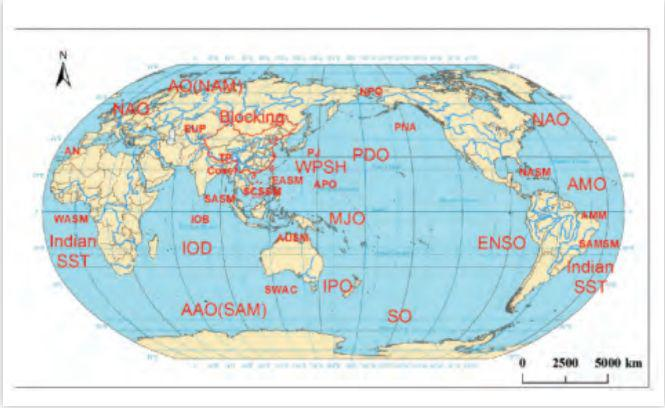
On March 11, 2016, the "attribute of extreme weather events in the context of climate change" published by the National Academy of Sciences Press pointed out that with the progress of science, weather changes caused by human activities affect the intensity and frequency of some extreme events.
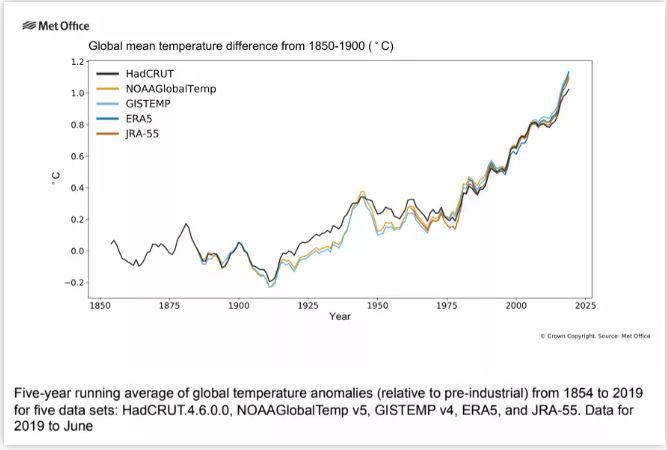
Climate change from 1854 to 2019
According to the World Meteorological Organization (WMO), warning signs and impacts of climate change (such as sea level rise, ice loss and extreme weather) increased in 2015-2019, the hottest five years on record. The concentration of greenhouse gases in the atmosphere has also risen to a record level, locking in the warming trend of future generations.
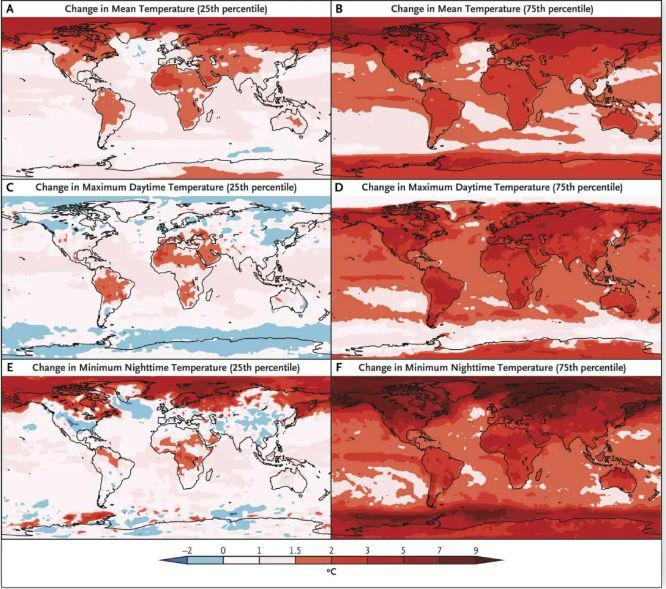
Potential regional temperature changes in the next 30 years in a world where the global average temperature is 1.5 ° C higher than the pre industrialization average temperature
Under the background of global warming, extreme precipitation events are likely to increase in a larger proportion in areas with increased total precipitation. Even in some areas with reduced average precipitation, extreme heavy precipitation events are also found to have an increasing trend. This conclusion is confirmed by studies in the United States, Canada, Japan, Britain, Norway, South Africa, Brazil and Russia. For China, the trend of total precipitation is not obvious, but the intensity of extreme precipitation is increasing. Recent frequent flood disasters at home and abroad are also confirming this.
The New England Journal of medicine quoted previous studies by who to estimate that between 2030 and 2050, about 250000 people will die each year due to the chain reaction of extreme weather and infectious disease risk caused by climate change. This is a conservative estimate because it does not include deaths caused by other sensitive health outcomes, nor does it include incidence rate, extreme weather and climate events and the interruption of health services.
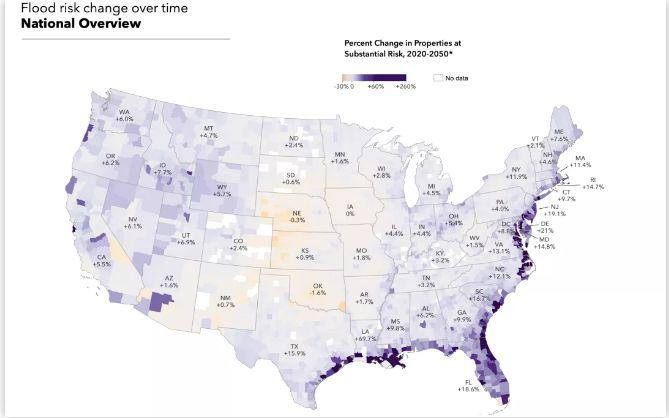
Us flood risk view
In the context of climate change, coupled with people's interference with river basins and riparian zones, and the increasing number of bad land practices (such as deforestation, upstream land degradation and excessive surface water caused by farming methods), it is considered to be the main driving force of recurrent floods in many places. Frequent floods have caused an unprecedented impact on a global scale. This change may affect human health in a variety of ways, such as drowning, accidental injury, outbreak of gastroenteritis, respiratory infection, cholera, diarrhea, dengue fever and many other epidemics. It can also increase depression and depression by changing the geographical scope and seasonality of some infectious diseases Anxiety and other mental health disorders.
Infectious disease risks mainly include water borne diseases, such as typhoid, cholera, leptospirosis, hepatitis A and vector borne diseases, such as malaria, dengue fever and dengue hemorrhagic fever, yellow fever and sinaro River fever.
Infectious disease events caused by global floods
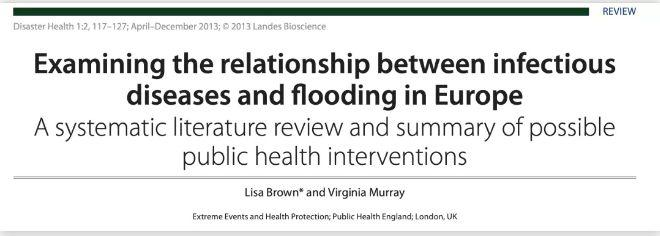
Brown and so on, through 38 flood events, showed that water borne infectious diseases, rodent transmission and vector borne diseases in Europe were related to floods, though the incidence rate was lower than that in developing countries. China animal husbandry. The research conclusion also believes that strengthening disease monitoring and early warning system, effective prevention and improving response capacity can reduce the risk of infectious disease outbreak after flood.
Outbreaks of infectious diseases (waterborne infectious diseases, rodent borne diseases and vector borne diseases) will occur with the time of flood.
Study on the relationship between waterborne infectious diseases and floods
This may be related to the decline of human resistance to bacteria caused by flood. Flood natural disasters can lead to famine, lack of safe and hygienic drinking water, mosquito breeding, etc., which will reduce the resistance of the affected population and increase the risk of exposure to infectious diseases, resulting in a large-scale outbreak of infectious diseases. On the other hand, related to seasons, floods all over the world mostly occur in the rainy season. For example, floods in China mostly occur in summer, with strong air mobility, which makes the transmission route wide and the transmission speed fast, and promotes the increase of the risk of infectious disease outbreak.
Other health risks include drowning, injury or trauma, increased risk of electric shock, power failure related to flood, traffic impact may damage public health services (such as water supply, etc.), interruption and all lifeline systems can have a huge impact, resulting in food shortage, thus increasing the risk of water-borne diseases as described above, However, it may also affect the normal operation of health facilities, including the cold chain. Moreover, being trapped in floods for a long time, hypothermia may also be a problem, especially for children. In theory, it is possible for toxic chemical pollution to occur during floods, but no conclusive link has been observed or determined so far.
Although in the short term, floods may have limited impact on the spread of infectious diseases, long-term continuous floods can lead to a significant increase in the risk of water-borne and insect borne diseases. Under the superposition of the global new crown pandemic, floods may exacerbate the risk of fear of health. The health system should formulate effective adaptation measures to reduce the health risk caused by floods.
Sudden rainstorm may lead to regional government failure, including communication interruption, power interruption, signal disappearance, public information system interruption, etc. On the one hand, the government should make a plan for sudden disability and actively organize to restore the government's command and rescue function. On the other hand, in the absence of government organization and command, every member of the whole society should do a good job in self-help within the possible scope.